Season Ticket Churn Prediction & Client Health Modeling
Predictive analytics project completed at OC Sports & Entertainment, focused on identifying season ticket members at risk of dropping out rather than renewing their plan, with the goal of improving retention strategy, sales prioritization, and fan engagement.
Project Snapshot
- Organization: OC Sports & Entertainment
- Context: Sports analytics / CRM / customer retention modeling
- Population: ~2,000 season ticket plan holders
- Dataset: Large-scale CRM and ticketing engagement data
- Problem Type: Supervised classification / churn risk scoring
- Target: Probability that a fan would stop purchasing within a future time window
- Model Family: Tree-based classification models
- Tools: Python, pandas, scikit-learn, CRM analytics workflows
Overview
This project was built to help business and sales teams identify season ticket members who were at risk of churn before the renewal window. Rather than waiting until a fan failed to renew, the goal was to surface leading indicators of disengagement early enough for teams to take action through more personalized and proactive outreach.
I developed a churn prediction model using CRM, ticketing, and engagement data, then extended that work into a broader client health model that could run consistently throughout the season. This allowed sales reps and marketers to monitor fan health over time, prioritize outreach, and better understand which behaviors signaled elevated churn risk.
What I Worked On
- Prepared and modeled large-scale CRM and ticketing data for season ticket members
- Engineered behavioral features tied to engagement, attendance, and purchase activity
- Built supervised classification models to estimate churn probability
- Evaluated multiple modeling approaches and selected tree-based methods
- Calibrated model outputs to support reliable downstream probability-based decisions
- Reframed the churn model into an always-on client health monitoring workflow
- Integrated scores into internal analytics processes for sales and retention teams
Technical Approach
The project began with extensive feature engineering on a large CRM dataset covering approximately 2,000 season ticket plan holders. The objective was to capture not only who had churned historically, but which ongoing behaviors served as early warning signs of future churn.
I built features representing:
- Purchase frequency and recency of transactions
- Ticket type segmentation and plan-related behavior
- Historical attendance patterns
- Customer demographic attributes
- Ticket forwarding behavior
- Email engagement and communication responsiveness
- Event participation and other fan interaction signals
I framed the task as a supervised classification problem and trained models to predict the probability that a fan would stop purchasing tickets within a defined future time window. Multiple approaches were evaluated, with tree-based models ultimately selected because they handled nonlinear relationships and feature interactions well across a high-dimensional behavioral dataset.
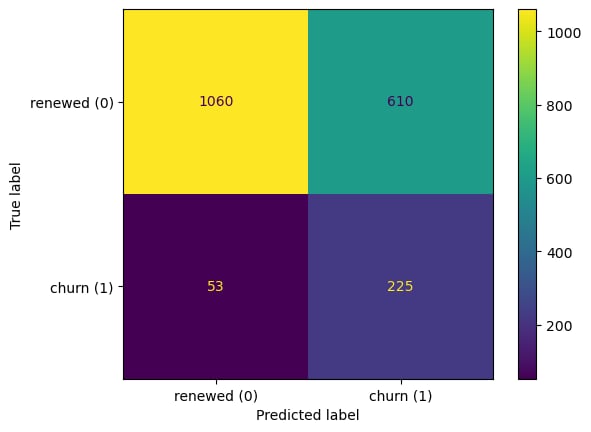
Model evaluation emphasized practical business value rather than raw accuracy alone. In particular, recall on the churn class was prioritized so that more at-risk fans could be identified early, while still balancing the downside of false positives that could waste sales and marketing effort. I also calibrated the model outputs so predicted risk scores could be used more reliably in downstream targeting workflows.
From Churn Model to Client Health Model
One of the most valuable outcomes of the project was that it evolved beyond a one-time churn prediction exercise. I converted the model into a client health framework that could run throughout the season and continuously highlight accounts showing signs of disengagement.
Fans with concerning patterns — such as not attending games, forwarding tickets, missing events, not opening emails, or not responding to calls — could be flagged for proactive outreach long before the renewal period. This turned the project into a more actionable retention system rather than just a retrospective churn score.
Business Impact
The final model was integrated into internal analytics workflows and used by business teams to segment users by churn risk and prioritize retention efforts. This enabled more targeted campaigns, improved visibility into customer lifecycle dynamics, and gave sales reps a more intelligent way to allocate their time and outreach.
The framework also created opportunities for experimentation. Because fans could be segmented by modeled health and churn risk, the business could use the scores for A/B testing, lift measurement, and ongoing optimization of personalized retention strategies across a large and diverse fan base.
Why It Matters
In subscription-like sports products such as season ticket plans, retention is often more valuable than acquisition alone. This project showed how machine learning can help organizations move from reactive renewal efforts to proactive relationship management by identifying disengagement patterns early and translating them into operational action.
More broadly, it demonstrated how predictive modeling can support CRM strategy by combining transaction history, behavioral engagement, and communication signals into a scalable system for monitoring customer health over time.
Key Takeaways
- Behavioral feature engineering was central to identifying meaningful churn risk signals
- Tree-based models were well suited for nonlinear CRM and engagement data
- Recall and probability calibration mattered more than headline accuracy alone
- Turning churn prediction into a client health system made the model more actionable
- Predictive retention tools can improve sales prioritization, outreach strategy, and long-term fan engagement